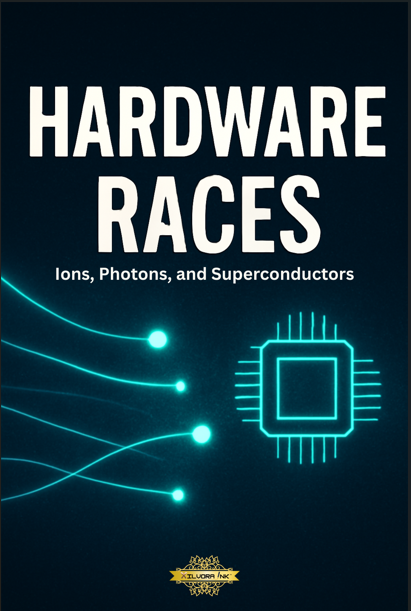
Hardware Races: Ions, Photons, and Superconductors
About This Book
Quantum computing will not be defined by a single breakthrough—it will be shaped by competing hardware paths, each with different strengths, limits, and timelines. Hardware Races: Ions, Photons, and Superconductors breaks down the global race to build practical quantum machines by examining the technologies behind them.
This book takes a comparative, engineering-focused view. It explains how trapped ions, photonic systems, and superconducting qubits work at a physical level, and why each approach solves some problems while creating others. Rather than declaring winners, the book shows why tradeoffs in scalability, error rates, control, and cost determine real progress.
Readers are guided through how hardware choices affect algorithms, error correction, and commercial viability. The focus is on understanding constraints—not hype—so readers can interpret announcements and roadmaps with clarity.
Readers will gain insight into:
• Why no single hardware approach dominates yet
• How ions, photons, and superconductors differ fundamentally
• What scalability actually means in practice
• Why engineering matters more than qubit counts
• How hardware choices shape the future of quantum use cases
This book is for readers who want to understand the machinery behind the promises. If you care about *how* quantum computers are really being built—and why progress looks uneven—this book gives you the lens to evaluate the race intelligently.
Book Details
| Title | Hardware Races: Ions, Photons, and Superconductors |
|---|---|
| Author(s) | Xilvora Ink |
| Language | English |
| Category | Quantum Computing |
| Available Formats | Paperback |