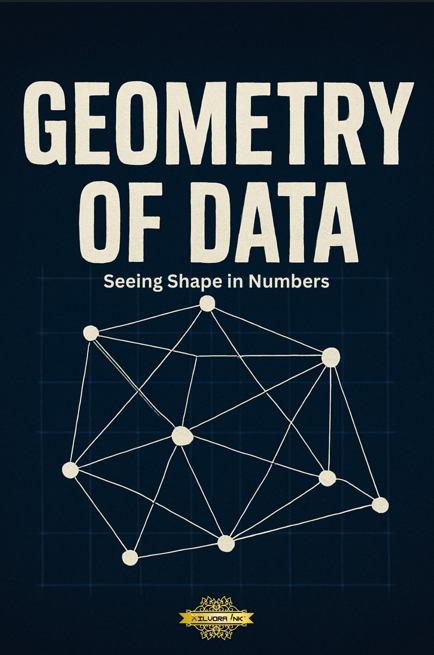
Geometry of Data: Seeing Shape in Numbers
About This Book
Data is not just rows and columns—it has shape. Geometry of Data: Seeing Shape in Numbers reveals how geometric thinking helps us understand structure, similarity, and meaning hidden inside high-dimensional data.
This book takes a visual-and-intuitive perspective. It explains how distance, angles, curvature, and manifolds turn raw numbers into patterns we can reason about. Rather than focusing on algorithms alone, the book shows how geometry provides the language to describe clusters, trends, and anomalies.
Readers discover why dimensionality changes intuition, how projections preserve or distort information, and why many learning methods succeed by exploiting geometry rather than statistics alone. Examples span data science, machine learning, visualization, and scientific modeling.
This book explores:
• How geometry gives data interpretable structure
• Why distance defines similarity and separation
• How high dimensions reshape intuition
• Why manifolds explain real-world data
• How seeing shape improves understanding
This book is for students, analysts, and thinkers who want to *see* data, not just compute on it. If numbers hide structure, this book shows how geometry brings it into view.
Book Details
| Title | Geometry of Data: Seeing Shape in Numbers |
|---|---|
| Author(s) | Xilvora Ink |
| Language | English |
| Category | Math & Logic |
| Available Formats | Paperback |